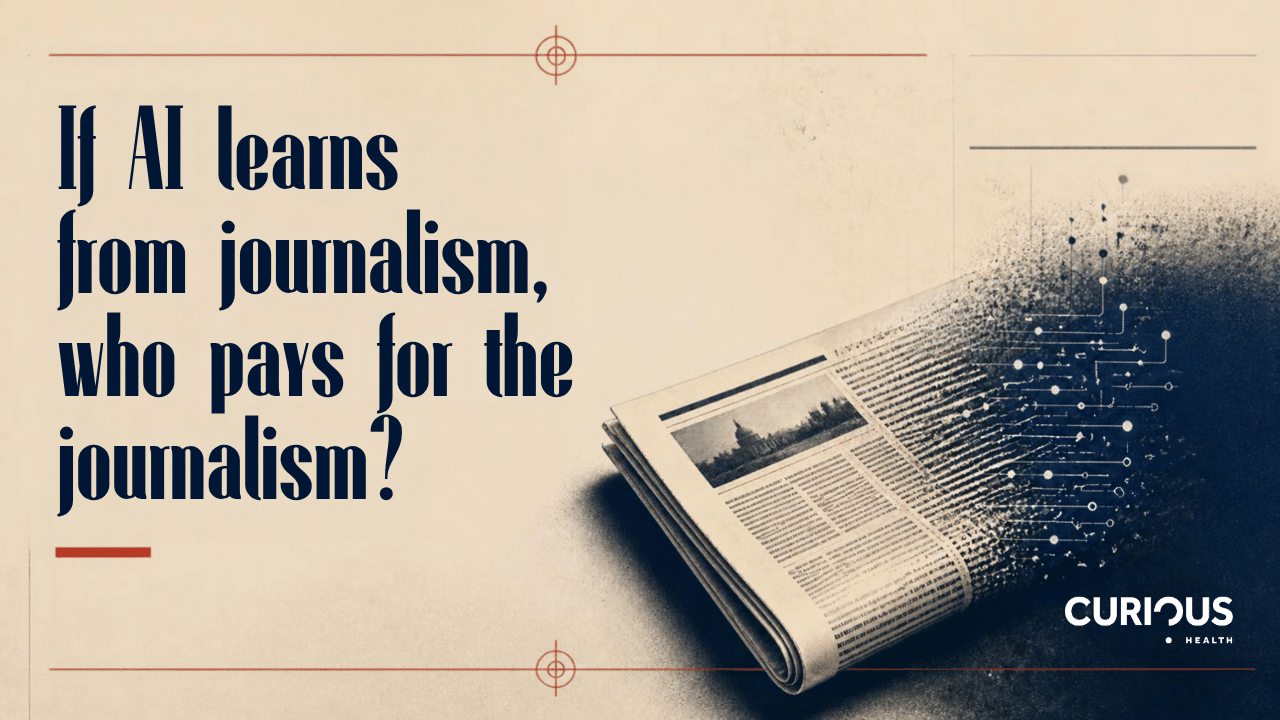
If AI learns from journalism, who pays for the journalism?
The announcement that Reach, publisher of the Mirror, Daily Express and dozens of regional titles, is cutting a further 220 editorial roles has reignited debate about the future of journalism in the age of AI. It would be easy to present this as a simple story of AI replacing reporters. The reality is considerably more nuanced.
Publishers and broadcast organisations have been navigating disruption for years. Audiences increasingly consume information through streaming platforms, social channels, newsletters, podcasts, creators and AI-powered search. Traditional media are responding by reshaping their businesses, investing in new formats and recruiting different skills, even as traditional editorial roles disappear. Reach itself is creating around 60 roles focused on digital revenue growth alongside its latest cuts.
Yet the pressure on journalism cannot be ignored. Press Gazette recorded at least 3,444 journalism redundancies across the UK and US during 2025, although that was lower than its totals for 2024 and 2023. The picture was one of restructuring as well as contraction. Reach cut roles while creating new positions largely in video and live news. ITV announced more than 220 redundancies while reinvesting in programming considered more suitable for streaming. People Inc cut jobs but also reported hiring hundreds of people to support new areas of growth.
So, this is not solely a story about AI. It reflects a wider transformation in what audiences want, where they go for content and how that content generates revenue. However, AI summaries and search overviews are undoubtedly part of the disruption. Reach reported a 46% year-on-year decline in traffic referred by Google as tools including AI Overviews increasingly gave users answers without requiring them to visit publishers’ websites.
For healthcare communications, this creates an uncomfortable paradox. The rise of large language models (LLMs) offers enormous potential to make health information more accessible. Yet LLMs often cite and draw value from the independent reporting that their growth may also be placing under pressure.
The promise of more accessible health information
People are turning to tools such as ChatGPT, Gemini and Perplexity to understand symptoms, explore treatment options and prepare for appointments. At their best, LLMs can translate complex language, organise information and respond to follow-up questions in a way that feels immediate and personal.
This has real value. Healthcare information has not always been written around the needs of the person searching for it. Dense language, complex systems and hurried consultations can all leave people seeking greater clarity. Conversational AI can help them formulate questions and make sense of what they have been told.
We should champion that potential, provided the information is accurate, appropriately qualified and supported by credible sources.
But an AI answer does not emerge from nowhere. Its quality depends on the information ecosystem behind it.
SEO versus GEO
It is worth noting at this point that owned content has a role to play in ensuring that LLMs have access to quality, evidence-based content that meets the needs of stakeholders. Also, while the search landscape is changing, SEO remains the foundation. LLMs value many of the signals that Google values. Our friends over at Performance IO have recently published this excellent article explaining the need for both SEO and GEO.
Owned online content must signal topical authority, well-structured content and technical quality to have both Google and LLMs recognise it as a trusted source.
Journalism as critical infrastructure
Independent journalism is part of the critical infrastructure of trust.
Journalists don’t just repeat announcements. They interrogate evidence and challenge claims. In health, they distinguish between an interesting early finding and a meaningful clinical advance. They seek independent expert opinion, explore limitations and place individual developments in a wider social and healthcare context.
This scrutiny provides something brand-owned content cannot replicate: genuine independence.
That is why earned content has always mattered to healthcare communications. Its value comes from giving information to a third party who decides whether it is relevant, credible and newsworthy. If it ticks the boxes, it might be written up and shared.
Today, when people ask questions of LLMs, platforms will draw heavily from the same independent information ecosystem that gives earned media its authority.
If fewer journalists are funded, there will be fewer original sources for AI tools to learn from, retrieve and summarise.
A question of diversity
A free press does not guarantee perfect information. News organisations make mistakes. Outlets have different editorial positions and commercial pressures have always influenced what gets covered.
Its value lies partly in plurality. Different journalists ask different questions. Specialist, national, regional and community media bring different experiences and agendas to the same subject.
If fewer journalists are producing original reporting, fewer perspectives enter the information ecosystem. Fewer investigations are commissioned. Fewer specialist health reporters challenge assumptions or surface emerging issues.
Another risk is different AI systems already favour different sources, while licensing arrangements and platform decisions influence which voices are amplified. This creates the possibility that users are exposed to a narrower set of perspectives without ever realising it.
For healthcare, where nuance and context are essential, that should give us pause.
AI can make the world’s information feel conveniently condensed. We must be careful it does not also make it less diverse.
What this means in healthcare
For life science companies and healthcare communicators, the familiar evaluation metrics will need to evolve. An article’s influence cannot be understood through ‘readership’ alone if its reporting is subsequently cited, summarised or used to shape answers elsewhere. We need to consider whether credible coverage is entering the wider information ecosystem, which sources LLMs use and how evidence is framed when people ask health questions.
It is in all our interests to protect media plurality. That means continuing to invest in genuine news, expert access and evidence-led storytelling rather than seeing media as an outdated channel. It means respecting editorial independence and demonstrating the value of specialist health reporting within our own organisations.
AI developers and platforms also have responsibilities around attribution, transparency, licensing and sustainable value exchange with the publishers whose work supports their products.
We should not be forced to choose
This is not a choice between journalism and AI. Society needs both.
We need journalists to challenge and interpret information. We need AI to help people find and understand accurate answers to their questions. The task is to ensure that easier access does not undermine the foundations of trustworthy knowledge.
A future in which AI can answer every health question, but fewer people are left to undertake the original reporting, would not represent progress. It would leave us with increasingly sophisticated tools drawing from an increasingly impoverished information ecosystem.
Now is the time to recognise independent journalism for what it is: not a legacy channel, but essential infrastructure for trust in an AI-powered world.
If you’re looking how to use earned content to optimise how your organisation or therapy area is being interpreted by LLMs, get in touch with the Curious Health team at st*********@*****us.io