2025 healthcare communications predictions: marking our own work
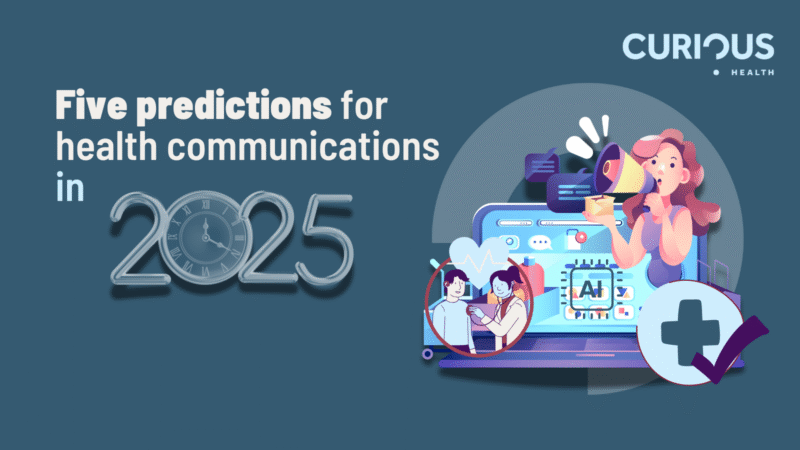
Every year, we dust off our (slightly battered) crystal ball and predict the trends that will shape healthcare communications. But how accurate are we? Well, this year we’ve looked back over 2025 to see how our predictions played out.
Last year we started out on an optimistic note:
“While we acknowledge there are events happening in the world that we cannot and should not ignore, we are going to look at our predictions for healthcare communications through a lens of optimistic yellow, and with a curiosity to help build resilience.”
2025 sure has tested that mentality.
Political shocks, economic strain and climate anxiety shaped the year. Yet moments like UK DJ, presenter and author Sara Cox raise over £10m for the BBC’s Children in Need by running five marathons in five days remind us that resilience and generosity shine through. As Sara said “while there is a lot of madness in the world at the minute, there is a lot more love.”
So, how did our December 2024 predictions perform?
1. Competition, Collaboration and Community in Pharma & Biotech
Prediction: “We will see new levels of collaboration to co-create systems and solutions… companies who are otherwise competitors will join forces to tackle a shared problem.”
2025 Evidence: That’s exactly what happened. Under pressure from pricing reforms, workforce shortages and regulatory complexity, pharma looked outward rather than inwards.
Companies are collaborating to tackle shared problems:
In June BMS and BioNTech announced a major collaboration to co-develop pumitamig, a next-generation immuno-oncology therapy
Gilead Sciences and LEO Pharma entered a strategic partnership to accelerate development of oral STAT6 programmes for inflammatory diseases
A landmark partnership committed $120 million of private industry investment from AstraZeneca, Eli Lilly, and Merck working jointly with the Virginia Innovation Partnership Corporation, the University of Virginia, and other stakeholders to develop the Virginia Center for Advanced Pharmaceutical Manufacturing.
In another kind of private-public collaboration, is the partnership of digital pharmacy startup Phlo with supermarket chain Morrisons to launch an online pharmacy clinic.
2. “AI Everywhere, Trust Nowhere?” – Authentic Stories Win
Prediction: While AI can “supercharge” our ability to analyse and produce content, it also makes it much harder for audiences to tell what’s real versus machine-made. To cut through generic, automated noise, brands and creators must double down on authenticity, using real, human stories and clear signals of trustworthiness.
2025 Evidence: This prediction hit the mark. Surveys and industry research throughout 2025 confirm that while people are increasingly accessing health information via AI, they remain selective and cautious. A study published in Journal of Medical Internet Research found that most participants consulted search engines (98%) and health-related websites (68.4%) for their health information, while 21.2% used LLMs, with ChatGPT and Microsoft Copilot being the most popular. This paper found that use for health information is increasing, despite scepticism. People value the convenience and speed of AI platforms as part of their search, but alongside some kind of validation.
Generative AI did become a normal part of producing healthcare content, yet audiences grew more sceptical about what they consumed. AI can generate content, but it can’t generate trust. Trust has to be earned by authenticity, accuracy, and empathy, all areas where human communicators excel.
3. The Misinformation Epidemic Becomes a “Pandemic”
Prediction: Building on a 2024 warning, we cautioned that in 2025 the health misinformation epidemic could escalate into a full-blown pandemic.
2025 Evidence: Unfortunately, correct. We hardly need list the ways in which this trend is playing out. Here are a few ‘low-lights’.
ECRI (a US patient safety institute) ranked medical misinformation as the third most critical patient safety concern for 2025, specifically highlighting its link to recent alarming measles outbreaks and challenges to vaccine campaigns in the US.
A paper in Health Promotion International also identified misinformation as a major threat to society and public health, with social media serving as an “amplifying ecosystem.”
In June, a peer-reviewed scoping review in JMIR Infodemiology found that the prevalence of health misinformation on social media continues to rise, especially on vaccines (32% of observed content), drugs (22%), and noncommunicable disease topics (19%). Widespread anti-vaccine posts led to decreased vaccine acceptance and increases in preventable disease outbreaks in 2025.
We saw more evidence that misinformation disproportionately affected vulnerable populations. Consequences included reduced adherence to public health measures, increased vaccine hesitancy, and erosion of trust in healthcare systems.
4. Taking a Break from Social Media – The Digital Detox Trend
Prediction: The burden of endless negative news and comparison culture on platforms was increasingly linked to mental health struggles. The blog suggested that younger generations might start to log off more frequently or even switch to simpler devices (“dumb phones”) that limit social apps.
2025 Evidence: I mean, team Curious Health has made a deliberate effort to stop doom scrolling. What more evidence do you need?
For readers who do insist on independent sources, our friends at Brandwatch have published their State of Social 2026 report. Within, they report that mentions of digital detox have increased by 10% during 2025. This presents an opportunity for companies to respect consumers’ choices, and create experiences that feel supportive rather than overwhelming. This will help build engagement and trust.
5. Loneliness Recognised as a Health Issue
Prediction: Loneliness would be treated as a public health priority. We argued that health brands need to consider how to create a sense of connection and engage people in meaningful ways to address this.
2025 Evidence: No less than the World Health Organization, issued its landmark global report From loneliness to social connection: charting the path to healthier societies stating that 1 in 6 people worldwide are affected by loneliness and linking it to more than 871,000 deaths annually (around 100 deaths every hour). The report calls social connection a “vital determinant of health” and urges governments to make social connection a public health priority on par with other major risk factors.
A survey and analysis by University of Exeter, published in PLOS One, found that about 40% of Britons reported feeling lonely at least sometimes, and around 8% were often lonely. The researchers linked survey data to healthcare usage and found that people who often feel lonely cost the National Health Service around £850 more per year than those who are not lonely.
An update from our predictions for 2024
While we didn’t cover VPAG as part of our 2025 predictions, as it has been such a factor of UK Life Sciences this year, we thought it was worth revisiting Predictions for healthcare communications in 2024 | Curious Health. In December 2023 we outlined three ways in which VPAG will impact the industry:
1) Differential rebates would be introduced (higher paybacks on newer medicines),
2) Rebate percentages would likely remain high for years, not dropping to pre-COVID low levels until 2027/28. We cited fears that the new terms could be “highly damaging to the UK life sciences sector, and to patients’ access to medicines”
3) For agencies, the implication was the theme of cost-containment would continue – clients would be extremely budget-conscious, seeking maximum value for spend.
Unfortunately, this trend has unequivocally been borne out by events. The impact of VPAG in 2025 has been significant, creating exactly the pressures and industry responses that were predicted.
Compounding this is the potential impact of the Most Favoured Nation (MFN) policy. By September, The Guardian was reporting that pharma had paused nearly £2bn in UK investments in 2025.
Where do we go from here? Much is still unknown about how MFN will be implemented. It is wise to acknowledge though, that healthcare systems do require reform, both in the US and rest of world. The life sciences industry, and governments must find a balance between affordability and access to innovative therapies. As this excellent article in Pharmaphorum summarises:
“Patients don’t experience drug pricing as policy debates; they experience it as moments of diagnosis, treatment, and hope. Access delayed is access denied. If the UK and US get this….right, they can set the standard for balancing affordability with innovation, ensuring patients from Manchester to Minnesota receive the best of both.”
We’re getting all Mystic Meg again right now, so stay tuned for our predictions for healthcare communications in 2026…